American Ltd

Recent Posts

How Do I Name My Business?

Posted by American Ltd on Aug 11, 2015 8:30:00 AM

Understanding the Basics

Naming my business incorporate llc question answer

Before you get started in your new business venture you will have to establish a name! Your business name is going to be one of the largest parts of your brand's identity and for many people the naming process is an exciting one that allows for creativity. It is important to pick a name that has both meaning to your customers and relevance to your product or service. Choosing a name that is both professional and creative can help your business stand out from competitors in the same field.  

Before beginning the process it is important that we address the answers to your most common naming questions:

1) Can I pick any name I want for my company? 

Generally yes, but naming conventions do exist and they vary state by state.  

  • You cannot name your company a name that is already in use in the state where you are forming.
  • There are limitations on corporate endings you can use. Many states limit the use of professional words such as "Accounting" or "Financial Services" to companies that have gone through a formal application process for the descriptor.
    • For LLC you can use: LLC or Limited Liability Company. For corporation you can use: Corp., Co., Inc., Ltd., or others depending on state law. 
  • Many states limit the use of 'less desirable' words in corporate names, as well. 

2) Can I change my company name after I incorporate?

Yes, you can file an amendment to your name at anytime.  The filing is done at the state level and is an easy process.  Just as with a new formation, the name you chose must be available for use in that state.  For assistance in filing an amendment please call: 800.421.2661

3) Do I have to reserve my company name ahead of time?

No, you do not. Although you certainly can reserve a name before formally incorporating, it is not required.  Many people reserve a name with their state of formation to assure that the trademark of that name is available before officially forming their company.  In some states, doing a name reservation ahead of time can save you time and money in the instance that your first choice name is not available. Other clients decide they really like a name and want to make sure it is available when they are ready to formally incorporate. Think of these scenarios in comparison to your own in order to help you decide!

4) How do I trademark my name?

AIL works closely with a third party vendor who specializes in trademark services.  The trademark process is entirely separate from the incorporation process and takes longer to complete.  

If time is of the essence we recommend you form your LLC or Corporation first and then begin the trademark process. In this instance, if your company name cannot be trademarked you can always file a name amendment and apply for a trademark for the new name! This will allow your corporation to maintain its original formation date.

If trademarking your name is a priority, we recommend you go through the trademark process first to secure the name you want. As mentioned in question 3, you can also file a name reservation with the state where you plan to incorporate while you wait for the trademark process to be completed. 


Find the answers to all of your major incorporation questions in our new eBook

New Call-to-action

subscribe to blog

Non-Profits, Corporations & LLCs, Oh My!

Posted by American Ltd on Aug 4, 2015 8:30:00 AM

What's the Right Choice For My Business?

which entity type  do I choose? question non-profit corporation llc

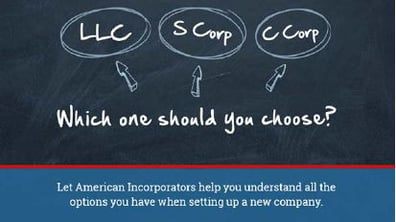
The primary entity types available in the United States are Corporations, Limited Liability Companies and Non-Profits. Corporations issue shares of stock to owners and are run by officers and directors. Limited Liability Companies (LLCs) are owned by members and can be run by the members or appointed managers. Non-profit organizations offer similar limited liability protections to corporations and LLCs, but have the added benefit of tax free existence as defined under section 501(c)(3) of the IRS Code. How do you know which entity type to choose? A lot of factors go into deciding which entity type is best for you.  These include legal liability, tax implications, costs and future needs.  This is an important decision and should be done after consulting a trusted accountant or attorney.  


Comparing Entity Types:


  C Corporations   S Corporations   LLCs         Non-Profits
Liability of Owners

Limited, even if shareholders participate in management

Limited, even if shareholders participate in management Limited, even if shareholders participate in management  Unlimited
Number of Owners No maximum Maximum 100 (as of 2005) No maximum, minimum of at least 2 One
Profit/Loss & Distributions Special allocations permitted separate classes of stock  No special allocations permitted Special allocations permitted N/A
Transferability of Interests No restrictions No restrictions, but must be eligible shareholder of "S" status terminates Restricted, typically requires approval of majority of members N/A
Federal Income Tax Maximum 35% on Corporation, plus tax on dividends to shareholders No corporate tax unless previously a C corporation None at LLC level Taxed on individual return


Find the answers to all of your major incorporation questions in our new eBook

New Call-to-action

subscribe to blog


The 3 Basics for First Time Incorporators

Posted by American Ltd on Jul 28, 2015 8:30:00 AM

What You Need to Know Upfront

incorporation basics questions answers These three questions always come first when beginning the incorporation process. Whether you are a new or experienced entrepreneur, incorporating is a major step in your business' future. The process can seem intimidating, but after consulting your attorney or accountant to determine the best entity and state of formation for your business venture read these three basics.

What do I have to do to incorporate?

Once you have decided on your entity type and state of formation, incorporating your new business is simple. Contact an incorporation provider like American Incorporators who has years of experience filing paperwork in all 50 states as well as the District of Colombia and Puerto Rico. They will walk you through a series of questions necessary to file the documents.  You need to know who will be listed as initial members or directors, as well as who will act as the registered agent for the company.  You will also need to explain the general purpose of your business.  If you are forming a corporation you will be asked about shares of stock and officers.

If you are ready with this information the entire process should only take 10-15 minutes. However, if you have questions our specialists are happy to take the time to walk you through every step.

Once the order is placed, documents will be filed with the state the same day and you should get your paperwork back in 2-10 business days depending on the state of formation. 

How much does it cost?

Prices for incorporation vary significantly depending on the state and services you are looking for. Click here for more info. Make sure to ask about hidden fees as you explore your options. You will have to pay state fees as well as service fees depending on who you use to form your company. Other items that can add to your costs are add-ons and registered agent service. Be sure to read the fine print in order to see what is included in the initial cost and what will be an additional cost after formation. 

How long does it take?

This really depends on where and how you form your company. In Delaware, businesses are generally formed the same day and documents are sent back to the client within 24 hours. If you are in a real hurry and are willing to spend a lot of money on expediting fees you can even form your company in an hour or two. In other states it can take a lot longer -- sometimes several weeks. 

Additionally, it can depend on how you file - in many states it makes sense to expedite your filing. In general, AIL tells clients expect Delaware documents in 1-2 days, if you expedite in other states expect them in 3-7 days, and non-Delaware non-expedited filings can be expected in 10-15 business days.

 Find the answers to all of your major incorporation questions in our new eBook

New Call-to-action

 subscribe to blog

What is a Registered Agent?

Posted by American Ltd on Jun 26, 2015 2:30:00 PM

Thinking of Incorporating? You'll Need to Appoint a Registered Agent

What’s a registered agent? This is a commonly asked question of entrepreneurs who are new to the incorporation process.  It is a statutory requirement that all entities appoint a registered agent, also known as resident agent or statutory agent, when incorporating.  The registered agent can be an individual or business entity and must have a physical address in the state of incorporation.  The primary responsibility of the registered agent is to receive legal correspondence on the entity’s behalf, in addition to, any official notices from the Secretary of State.  Failure to maintain a registered office in the state of incorporation can cause the entity to fall out of good standing and even be declared Void if a new agent is not appointed.

Designation of the registered agent is typically made on the formation documents.  There is often a misconception that the registered agent address is the same as the principal office address.  This is not the case.  The two are very different and serve different purposes.  Most jurisdictions allow business registered agent incorporate LLC corporation entities to maintain a principal place of business outside the state.  If the business does not operate or maintain an address in the state of incorporation, a commercial registered agent can be appointed.  If the business does operate or maintain an address in the state of incorporation, ie: director or officer, then either can be appointed as the registered agent of the entity.

There are many benefits of appointing a commercial registered agent.  The commercial registered agent maintains a physical address in the state and is staffed during normal business hours to accept all correspondence received on your company’s behalf.  The registered agent’s address is kept on file with the Secretary of State and this information is stored as Public Record.  Utilizing a commercial registered agent means that you need not worry about address changes or not receiving an important company document. 

American Incorporators Ltd. provides this service nationwide & is ready to assist with all of your corporate needs.  Contact us today!

Registered Agent Services


Find the answers to all of your major incorporation questions in our new eBook

New Call-to-action

subscribe to blog

Topics: Registered Agent, forming a business, registered agent Delaware, create a corporation

Subscribe to Email Updates

Recent Posts

Posts by Topic